






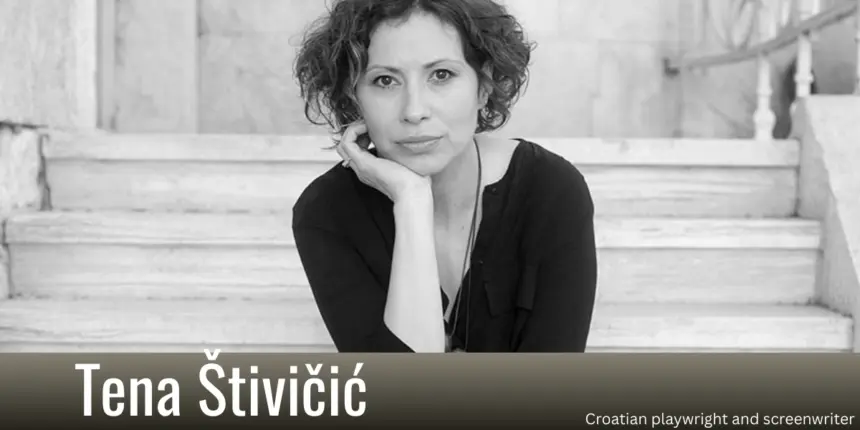
Tena Štivičić is a Croatian playwright and screenwriter who writes in English and Croatian. Born in Zagreb in 1977, she won the 2015 Susan Smith Blackburn Prize for Three Winters, which premiered at London’s National Theatre and explores 70 years of Croatian history through one family’s story.
When Tena Štivičić’s play Three Winters premiered at London’s National Theatre in 2014, critics recognized something special. The Croatian playwright had created a 70-year family saga that made distant history feel immediate and personal. Her work has since traveled from Tokyo to Vienna, earning her recognition as one of the most performed Croatian playwrights working today.
Born in Zagreb in 1977, Štivičić writes in both Croatian and English. Her plays explore family relationships, political change, and the experience of migration. She currently serves as Director of Drama at the Croatian National Theatre in Zagreb while maintaining strong ties to the UK theatre scene.
This article examines Štivičić’s career, her major works, her unique approach to bilingual playwriting, and her influence on contemporary European theatre.
Early Life and Education
Tena Štivičić was born in Zagreb where she studied at the Academy of Dramatic Art, earning a degree in dramaturgy in 2002. Her talent emerged early. During her third year at the Academy, she wrote Can’t Escape Sundays, which premiered at Zagreb’s ZKM Theatre and won both the Rector’s Award and the Marin Držić Award.
After graduating, Štivičić moved to London in the early 2000s. She completed an MA in Writing for Performance at Goldsmiths, University of London in 2004. This education in two countries shaped her career path. She learned to navigate different theatrical traditions and write for diverse audiences.
The move to London proved transformative. As someone who has personally experienced the feeling of being an outsider, she views this experience in a positive light. Migration became both subject matter and creative advantage, giving her fresh perspectives on both Croatian and British culture.
Early Career Success
Štivičić’s breakthrough came with The Two of Us in 2003. It was the first new Croatian play to be performed on a Belgrade stage since the break-up of Yugoslavia. The production at Belgrade’s Atelje 212 Theatre won audience awards and showed her ability to address regional tensions through personal stories.
Her early plays established recurring themes: gender dynamics, family structures, and the aftermath of Yugoslavia’s dissolution. She developed a distinctive voice that balanced intimacy with political awareness.
Major Works and Achievements
Three Winters
Her play 3 Winters premiered at National Theatre in London, and won Štivičić the 2015 Susan Smith Blackburn Prize. This award, given annually to the best new English-language play by a female playwright, marked her international breakthrough.
Three Winters follows four generations of the Kos family in Zagreb from 1945 to 2011. The play moves between three time periods: postwar Communist Yugoslavia, the violent 1990s independence war, and modern EU-era Croatia. With the flat as key setting, the play jumps over decades and introduces new characters from different generations.
The production received widespread acclaim. Critics praised Štivičić as a Croatian-born London resident who made her National Theatre debut with a complex and moving epic. Director Howard Davies brought the sprawling story to life on the Lyttelton stage.
Three Winters has traveled the world. Productions have appeared in Croatia, Slovenia, Japan, Austria, and Spain. The Zagreb production became the best-selling show in two decades at the Croatian National Theatre. In Tokyo, it won awards for best translation and best director at the Bungakuza Theatre.
Fragile! and Other Notable Plays
Fragile! (2004) brought Štivičić early international recognition. Inspired by her first year living in London, the world premiere at the Mladinsko Theatre in Ljubljana was pronounced the best annual performance at the Borštnik Festival in Slovenia. The play won the Best European Play Award at Heidelberg Stückemarkt in 2008.
The play examines language barriers and cultural displacement. Critics noted her writing is alert to the way the English language is imperfectly spoken by those not born to it. This attention to linguistic detail became a hallmark of her work.
Invisible (2011) tackled migration directly. Commissioned by London’s Bush Theatre, the play weaves together stories of displacement across different characters. Štivičić explored how migration affects identity and belonging, drawing on her own experiences as a Croatian living in the UK.
Other significant works include:
- Fireflies (2008) – developed at the National Theatre Studio
- Seven Days in Zagreb (2009) – part of the European Theatre Convention’s Orient Express project
- Europa (2013) – co-written with Steve Waters for the Royal Shakespeare Company
- 64 Shots (2021) – examining infertility and IVF treatments
- Cabaret Kaspar (2022) – for the Slovenian National Theatre Drama
Bilingual Writing and Craft
Štivičić’s bilingual practice sets her apart. She writes original work in both Croatian and English, sometimes translating her own plays between languages. She became particularly aware of how language shapes character when translating her own plays from English to Croatian.
Her English-language work captures the rhythms of non-native speakers. English, spoken by so many, in so many ways, is the most malleable of languages, an exciting thing to play with, she has said. Characters in her plays often speak imperfect English, reflecting real migration experiences.
This linguistic skill serves her themes. Language becomes a marker of displacement, adaptation, and identity. Her characters inhabit their words, revealing themselves through how they speak rather than just what they say.
Writing Process and Themes
Štivičić’s plays typically blend personal stories with broader political contexts. She avoids heavy-handed historical drama, instead choosing moments when futures remain uncertain. She shows times which are pregnant with meaning, those moments in history when things could go either way.
Her work centers female characters. The play, dominated by powerful female performances, is put in historical context by documentary footage. Women in her plays navigate political upheaval while dealing with family dynamics and personal ambitions.
Migration appears repeatedly in her work. She views displacement as feeling like other people are getting along with their lives very happily, but somehow you don’t know the password into that life. This metaphor captures the psychological reality of cultural transition.
Career Beyond Playwriting
Screenwriting
Štivičić has expanded into film and television. She co-wrote The Postcard Killings (2020), a thriller directed by Danis Tanović and based on a James Patterson novel. Her early screenwriting credit includes The World’s Greatest Monster (2003), a period film exploring marginalization in 1930s Yugoslavia.
She currently develops feature films with Screen Scotland and Croatian production companies. Projects in development include Acid and Mum, Dad and Me, continuing her exploration of family and identity themes.
Journalism and Columns
Since 2003, Štivičić has written a column in the Croatian magazine Zaposlena. These pieces blend personal reflection with social commentary on Croatian life and broader cultural phenomena. Her columns have been collected into three bestselling books: Odbrojavanje (2007), Vrag ne spava (2010), and Pepeljuga (2017).
Leadership Role
In June 2024, she was appointed Director of Drama at the Croatian National Theatre in Zagreb. This position represents her commitment to Croatian theatre despite her international career.
As director, she programs seasons, commissions new work, and supports the theatre ensemble. She has announced productions of Croatian classics alongside contemporary international work, balancing tradition with experimentation.
Personal Life
Tena Štivičić is married to Scottish actor Douglas Henshall. The couple lived in London for over 15 years before relocating to Glasgow in 2018. She found that London wasn’t a city for her three-year-old daughter to grow up in, and she wanted her child to speak Croatian as well as English.
Her family life reflects the bilingual, bicultural themes in her work. She maintains connections to both Croatia and Scotland, traveling regularly between the two countries. This divided life informs her understanding of migration and belonging.
International Recognition
Štivičić’s plays have been produced in over ten European countries. They’ve been translated into multiple languages and published by major theatrical publishers. Her work appears regularly at European theatre festivals and conferences.
Key honors include:
- Susan Smith Blackburn Prize (2015) for Three Winters
- European Authors Award for Fragile!
- Innovation Award at Heidelberg Stückemarkt (2008)
- Helena Weigel Prize for Theatre (2025) for The Scattered
She was nominated as one of the fifty most promising writers in Great Britain as part of The 50, a Royal Court Theatre initiative. This recognition came early in her UK career and opened doors to major commissions.
Productions of her work have appeared at prestigious venues including the National Theatre (London), Royal Shakespeare Company, Burgtheater (Vienna), and Berliner Ensemble. She is currently under commission by the Berliner Ensemble for a new play.
Impact on European Theatre
Štivičić represents a generation of playwrights working across national boundaries. Her success demonstrates how regional stories can resonate internationally when told with specificity and emotional truth.
She has helped bring Croatian theatre to international attention. Her works introduce foreign audiences to Croatian history while finding universal themes in specific circumstances. The family dynamics and political tensions in her plays translate across cultures.
Her bilingual practice challenges traditional ideas about theatrical language. By writing in multiple languages and exploring how non-native speakers use English, she expands what theatre can represent in an era of increased migration.
Teaching and Mentorship
Throughout her career, Štivičić has participated in development programs and workshops. She attended the Paines Plough Young Writers Programme and contributed to the Royal Court’s anniversary celebrations.
She works with emerging playwrights through her position at the Croatian National Theatre. Her leadership includes creating opportunities for new voices and experimental work in the theatre’s STAGES project.
Recent Work and Future Projects
In July 2025, she received the Helena Weigel Prize for Theatre for her play The Scattered, premiered at the Berliner Ensemble. This recent recognition confirms her continued relevance in European theatre.
She balances multiple projects across theatre, film, and her leadership role. Current commissions include work for the Berliner Ensemble and the Arcola Theatre in London. Her screenwriting continues with feature film development in both Scotland and Croatia.
Her position at the Croatian National Theatre allows her to shape the institution’s direction while creating her own work. This dual role connects her international experience with Croatian theatrical tradition.
Frequently Asked Questions
What is Tena Štivičić most famous for?
Štivičić is best known for Three Winters, which premiered at London’s National Theatre in 2014 and won the Susan Smith Blackburn Prize. The play spans 70 years of Croatian history through one family’s story.
Does Tena Štivičić write in English or Croatian?
She writes in both languages. Some plays are original English works, others original Croatian works, and she sometimes translates between the two languages herself.
Where can I see Tena Štivičić’s plays?
Her plays are produced across Europe in multiple languages. Three Winters has been staged in the UK, Croatia, Slovenia, Japan, Austria, and Spain. Check local theatre listings for current productions.
What themes does Tena Štivičić explore in her work?
Her plays focus on family dynamics, migration, political change in post-Yugoslav countries, gender roles, and cultural identity. She often examines how ordinary people navigate historical upheaval.
What awards has Tena Štivičić won?
Major awards include the Susan Smith Blackburn Prize (2015), European Authors Award, Innovation Award at Heidelberg Stückemarkt (2008), and the Helena Weigel Prize for Theatre (2025).
Conclusion
Tena Štivičić has built a remarkable career bridging Croatian and international theatre. Her plays make history personal, exploring how political change affects families and individuals. Through her bilingual practice and migration experiences, she brings unique perspectives to contemporary European drama.
From her breakthrough with Can’t Escape Sundays to her recent work at the Berliner Ensemble, Štivičić has consistently created theatre that matters. Her appointment as Director of Drama at the Croatian National Theatre shows her commitment to nurturing the next generation while maintaining her own creative output. As she continues working across borders and languages, Štivičić remains one of the most vital voices in European theatre today.